
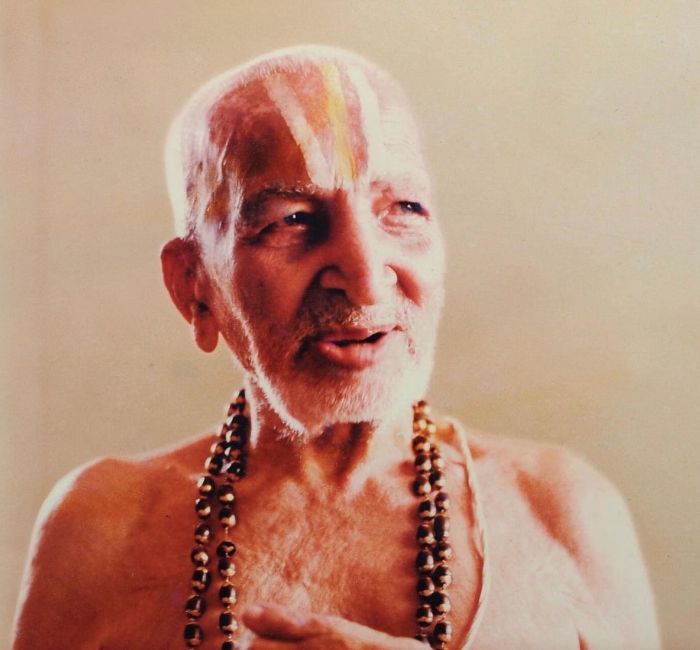
Śrī Tirumala Krishnamacharya
18 November 1888 – 28 February 1989
Śrī T Krishnamacharya’s Life HistoryA Brief Note Respected and revered as a great scholar in Veda-s, Śāstra-s, traditions, and an unparalleled exponent of Yoga, Śrī T Krishnamacharya was born in a small town by name Muchukunde (Muchukundapura) in Mysore presidency in the year 1888. He is a descendant of Yogi Nāthamuni, a Vaiṣṇavite saint from south of India, who lived in the 9th century. Śrī T Krishnamacharya’s father, Śrī Srinivasa Tātācārya taught Veda-s and religious texts to many students in the Gurukula style of education. Śrī Krishnamacharya had his early education from his father. At the age of 12, Śrī Krishnamacharya joined a Sanskrit college in Mysore and learned Sanskrit grammar and logic from Śrī Krishna Brahmatantra Swami. Later, he learnt Sanskrit from Pandits, in Vārāṇasi such as Vamacharana Bhattacharya and Ganganath Jha. During the next 15 years, he earned degrees in several areas of Indian Philosophy, and they include: 1. Sāṁkhya-yoga Sikhāmaṇi 2. Mīmāṁsā Tīrtha 3. Nyāyācārya 4. Vedāntavāgīśa 5. Nyāya Ratnā 6. Vedānta Kesari Śrī T Krishnamacharya became the disciple of Yogi Rama Mohana Brahmachari near Manasarovar Lake in West Tibet in the year 1917. He learnt all aspects of healing and treatment from his Guru and Yogic practices and facets of the body that control involuntary actions completely. Highly proficient in Sanskrit and an awardee of several university degrees, Śrī T Krishnamacharya spent seven years in Tibet learning Yoga techniques. Śrī T Krishnamacharya got married in the year 1924 as per his Guru’s wish and started leading a family life. With his abiding interest in teaching Yoga to others, he resolved to make all efforts in that direction. He declined many offers from universities to provide leadership to the departments of philosophy and religious studies. As a result of this, he had to withstand direct criticism even from his close friends and relatives. But many of them have become his disciples later because of his indisputable proficiency and scholarship. His reputation grew as he was spreading Yoga. The erstwhile King of Mysore State became his disciple in the year 1930 and as per the King’s request, he established a Yoga Centre in the palace. Śrī Krishnamacharya then continued to teach Yoga for the next 20 years. He spread Yoga by extensively travelling to various parts of India. Several of the then existing Kings became his disciples. They also encouraged their people to get involved in learning the ancient Yoga techniques. Thus, Śrī Krishnamacharya gained reputation among the people. Scientists and doctors of western countries started showing interest in understanding great powers of Indian Yogis. Many of them visited India to personally test and understand the powers of Yoga Siddha-s. Śrī Krishnamacharya subjected himself wholeheartedly to such scientific investigations in order to bring out the truth. Professor Venjar from California and Dr. Therase Braze from Paris visited India. Śrī Krishnamacharya demonstrated to them how to control electrical signals to the heart and make it function the way we want. He also demonstrated how to control pulse rate and completely stopped pulse for two minutes. Breathing methods while doing Yoga, making changes in Yoga techniques to suit individual needs, and the importance of close relationship between body, mind and breath became the core aspects of Śrī Krishnamacharya’s teaching. He has cured many diseases with the help of Yoga. Among them are diabetes, asthma, paralysis, chronic headache, insomnia, infertility in women, various problems of spine and heart related illnesses. There were occasions when other forms of medication failed, people have taken his help to examine the patients. Thus, Śrī Krishnamacharya has helped thousands of people in his 80 years of vast Yoga experience. The available publications containing Śrī T Krishnamacharya’s teachings now are: 1. Yoga Valli – Sanskrit Commentary to Yogasutra-s of Patañjali (Samādhi Pāda) 2. Yogāñjalīsāram 3. Dhyānamālikā Well known constitutional lawyer Śrī Alladi Krishnaswamy invited Śrī Krishnamacharya to Tamil Nadu in the year 1952 to help him with medication for some of his ailments. Śrī Alladi Krishnaswamy got cured of his diseases through his techniques. Among many prominent personalities who got benefitted, Śrī Patañjali Śāstri, the first Chief Justice of India, Śrīmati Ammu Swaminathan, a pioneer in social welfare and charity and others requested Śrī Krishnamacharya to stay in Tamil Nadu. Living up to the ripe age of 101 years, he left his body in 1989 and attained the lotus feet of his Ācārya-s.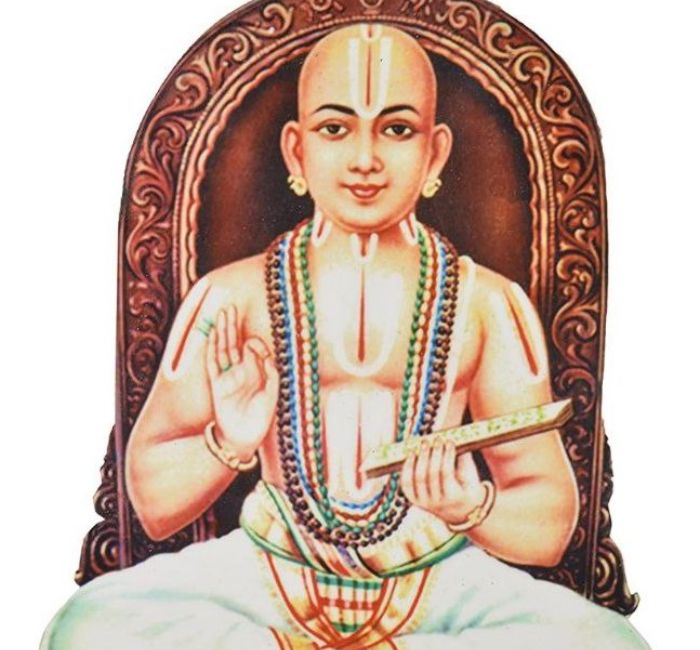
Sri Vedanta Desika
1268–1369
Also rendered Vedanta Desikan, Swami Vedanta Desika, and Thoopul Nigamantha Desikan, was an Indian polymath who wrote philosophical as well as religious and poetical works in several languages, including Sanskrit, Manipravaḷam (a Sanskritised form of literary Tamil), Tamil and Prakrit. He was an Indian philosopher, Sri Vaishnava guru, and one of the most brilliant stalwarts of Sri Vaishnavism in the post-Ramanuja period. He was a Hindu devotee, poet, Master of Acharyas (desikan) and a logician and mathematician. He was the disciple of Kidambi Appullar, also known as Athreya Ramanujachariar, who himself was of a master-disciple lineage that began with Ramanuja. Vedanta Desika is considered to be avatar (incarnation) of the divine bell of Venkateshvara of Tirumala by the Vadakalai sect of Sri Vaishnavism. Vedanta Desika belongs to Vishvamitra/Kaushika gotra.
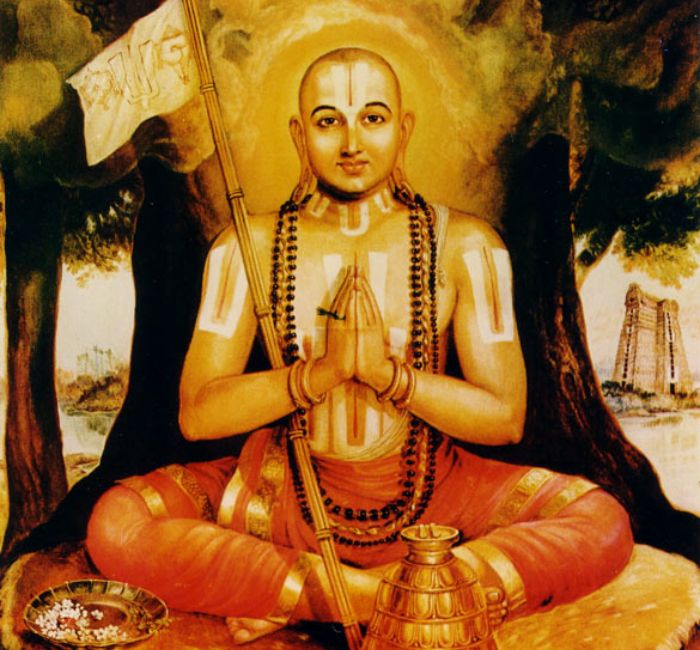
Sri Ramanujacharya
1077 – 1157
Pan Indian Hindu philosopher, guru and a social reformer. He is noted to be one of the most important exponents of the Sri Vaishnavism tradition. His philosophical foundations for devotionalism were influential to the Bhakti movement.
Ramanuja's guru was Yādava Prakāśa, a scholar who according to tradition belonged to the Advaita Vedānta tradition, but probably was a Bhedabheda scholar. Sri Vaishnava tradition holds that Ramanuja disagreed with his guru and the non-dualistic Advaita Vedānta, and instead followed in the footsteps of Tamil Alvārs tradition, the scholars Nāthamuni and Yamunāchārya. Ramanuja is famous as the chief proponent of Vishishtadvaita subschool of Vedānta, and his disciples were likely authors of texts such as the Shatyayaniya Upanishad. Ramanuja himself wrote influential texts, such as bhāsya on the Brahma Sutras and the Bhagavad Gita, all in Sanskrit.
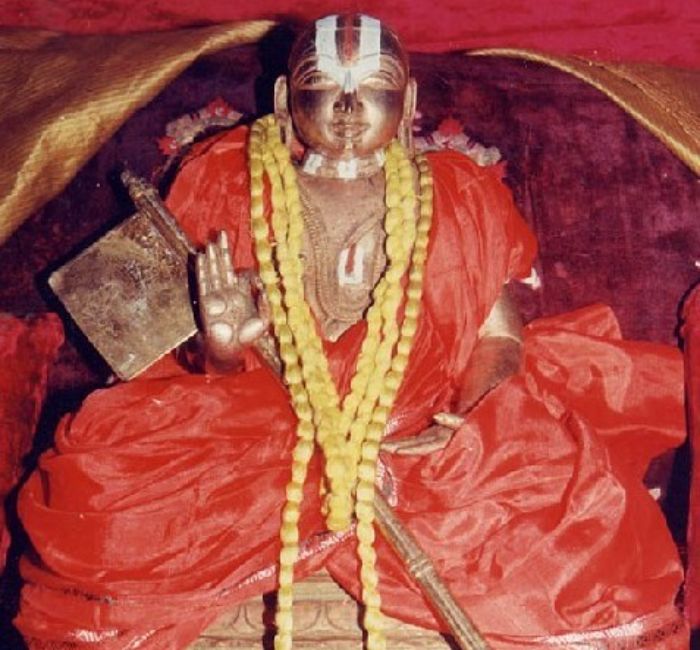
Yamunacharya
Early 10th century CE
Also known as Alavandar and Yamunaithuraivan, was a Vishistadvaita philosopher based in Srirangam, Tamil Nadu, India. He is best-known for being a preceptor of Ramanuja, one of the leaders of the Sri Vaishnava tradition. He was born in the early 10th century CE, and was the grandson of Nathamuni, a famed yogi, who collected the works of the Tamil Alvars.
Yamunacharya grew up learning Vedic texts from Rama Misra, and was skilled in the concept of mimamsa. According to Sri Vaishnava tradition, as a teenager, he challenged the royal priest of a Pandya king, Akkiyalvan, to a debate. Akkiyalvan, when he saw the age of the youth, sarcastically asked "Alavandara?", meaning "Has he come to rule me?". He defeated Akkiyalvan by logically proving that Akkiyalvan's mother was barren, the king was not righteous, and the queen unchaste. The king and queen, impressed that the boy had understood the shortcomings of logic, adopted him. The queen hailed the boy as "Alavandar". In other versions of the legend, he is given half the kingdom. There is no historical record to show his reign, so it is possible that this happened in a small village, rather than the kingdom of Pandya.
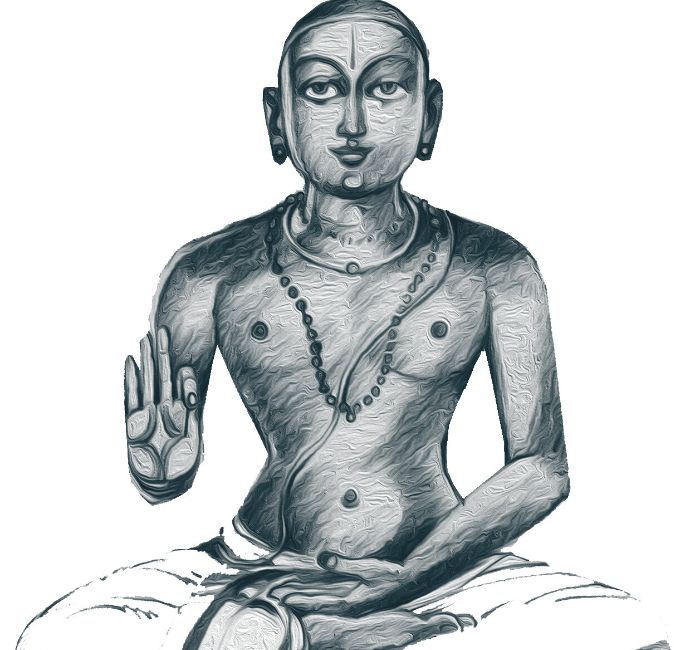
Śri Nathamuni
Autor of Yoga Rahasya
823 - 951 CE.
Though there is difficulty in identifying Nathamuni's date of birth and age, he is considered to have lived during the lifetime of Madhurakavi Alvar's parampara (lineage). According to Sri Vaishnava tradition, Nathamuni was conversing with his father about the legend of Prabandhams written by the Alvars. His father, Ishvara Bhattar, exclaimed the Prabandhams were long lost, and that they would be impossible to retrieve unless one had the grace of Narayana. Hence, he got interested in this and had set to the pilgrimage to the Kumbakonam Sarangapani Temple, where Vishnu is worshipped under the epithet of Aravamudhan. There, he heard priests singing 10 particular pasurams (hymns) dedicated to Aravamudhan (Sarangapani temple's main deity) by the saint Nammalvar. He was overjoyed hearing those and enquired its details. But the priests stated that only 10 pasurams was known to them out of 1,292 written by Nammalvar. He placed immense faith on the deity Aravamudhan and he visited Thirukurgur, birth place of Nammalvar.
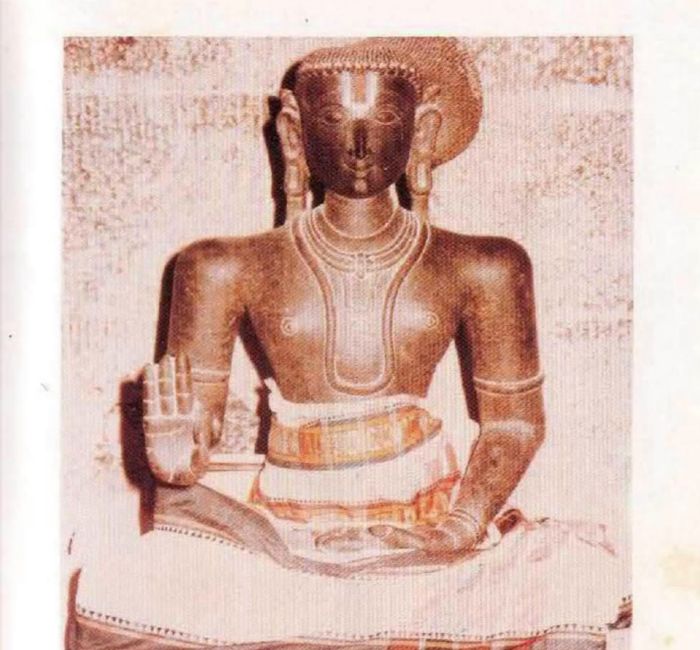
Śri Nammalvar
Nammāḻvār who was known as Vakulabharana, Śathari and Parānkusa, who is also the source of yoga, who introduced on the essence of the Vedas, was one of the twelve Alvar saints of Tamil Nadu, India, who are known for their affiliation to the Vaishnava tradition of Hinduism. The verses of the Alvars are compiled as the Naalayira Divya Prabandham, where praises are sung of 108 temples that are classified as divine realms, called the Divya Desams. Nammalvar is considered to be the fifth in the line of the twelve Alvars. He is highly regarded as a great mystic of the Vaishnava tradition. He is also considered to be the foremost among the twelve Alvars, and his contributions amount to 1352 among the 4000 stanzas in the Naalayira Divya Prabandam.